
Digital cards are not plastic cards with a digital photo. The role of digital cards in online commerce goes far deeper than that, and most e-commerce businesses are leaving real money on the table by treating them as a convenience feature rather than a strategic asset. Virtual payment cards, digital gift cards, and digital business cards each solve distinct problems. They reduce fraud exposure, accelerate checkout, retain customers, and open doors to markets that traditional payment rails simply cannot reach. If you run an online store and you are not actively building digital card strategy into your payment stack, your competitors are already ahead of you.
Table of Contents
- Key Takeaways
- The role of digital cards in online commerce
- How digital cards move the metrics that matter
- Security advantages that directly cut costs
- Practical implementation that actually works
- Future trends shaping digital card adoption
- My take: digital cards are a customer engagement strategy, not a payment feature
- How Pepecards helps you put this into practice
- FAQ
Key Takeaways
| Point | Details |
|---|---|
| Digital cards span three categories | Virtual payment cards, digital gift cards, and digital business cards each serve different but complementary e-commerce functions. |
| Conversion rates respond sharply | Offering three or more digital payment options can increase conversion rates by up to 89% for smaller online retailers. |
| Security gains are measurable | Digital wallet fraud rates run 91% lower than traditional card-not-present transactions, directly cutting chargeback costs. |
| CRM integration is non-negotiable | Without connecting digital card activity to your CRM, you forfeit the personalization and retention value these tools generate. |
| Younger buyers are already there | Digital wallets are the top payment method for 41% of U.S. consumers aged 25 to 34, making adoption a retention issue now. |
The role of digital cards in online commerce
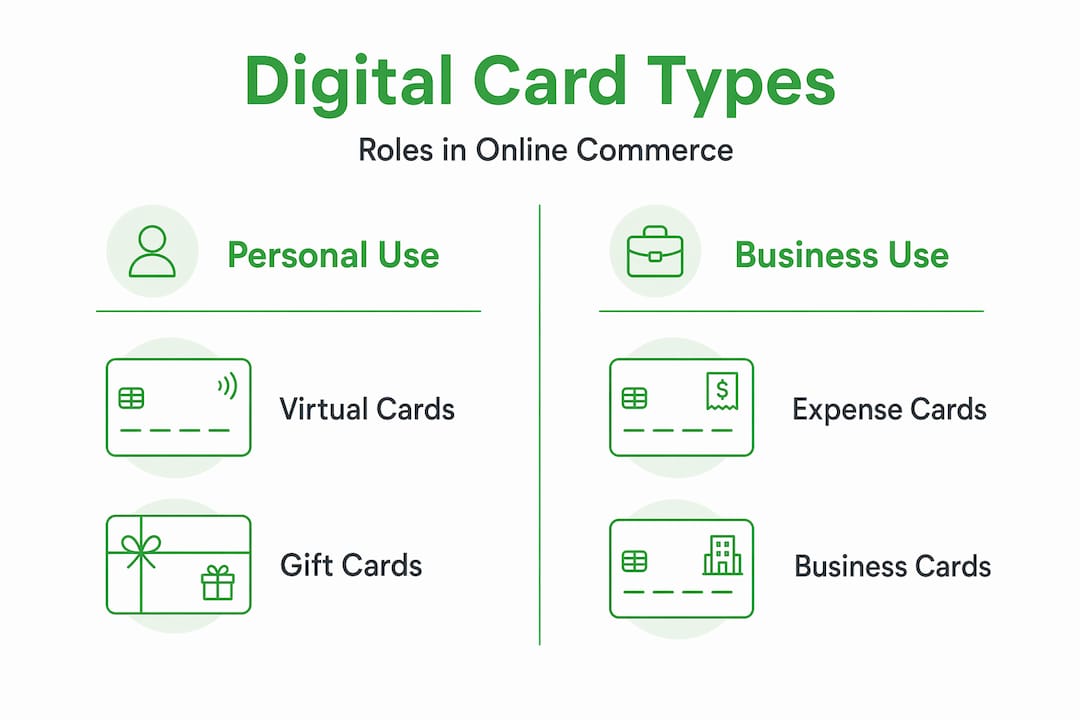
Not all digital cards do the same job. Understanding the three main types is the starting point for building a payment strategy that actually performs.
Virtual payment cards are temporary card numbers generated for a single transaction or a limited spending window. They sit between your customer's real card data and the merchant, so the actual account number never travels across the internet. For B2B buyers purchasing software subscriptions or ad spend, virtual cards also allow finance teams to set hard spending limits per vendor, which eliminates the manual approval bottleneck that slows procurement.

Digital gift cards are the quiet revenue engine most retailers undervalue. The digital gift card market is projected to nearly double to $698.3 billion by 2028, and retailers who build a real gift card program see conversion rates improve by 15 to 20% alongside a 25% lift in customer retention. Consumers also spend 40% less time choosing digital gifts versus physical ones, which removes friction at the decision stage.
Digital business cards serve a different function: B2B relationship building and brand promotion. Companies that switch from paper to digital business cards report 35% better follow-up rates and 55% higher contact information retention. The cost savings are significant too, with some organizations cutting printing and distribution costs by up to 90%.
Here is a quick comparison of how each card type maps to e-commerce goals:
| Card type | Primary function | Key e-commerce benefit |
|---|---|---|
| Virtual payment card | Secure transaction processing | Fraud reduction, spending control |
| Digital gift card | Customer acquisition and retention | Higher AOV, repeat purchases |
| Digital business card | B2B networking and brand promotion | Lead capture, follow-up automation |
How digital cards move the metrics that matter
The business case for digital cards is not theoretical. The numbers from Q1 2026 are direct: retailers that implemented three or more digital payment options saw a 67% revenue increase alongside a 52% drop in checkout abandonment. For SMBs under $10 million in annual revenue, that same move increased conversion rates by 89%.
Checkout abandonment is where most retailers bleed. A customer who reaches the payment screen has already made the buying decision. If your checkout requires them to find their physical wallet, type 16 digits, and then pass a 3D Secure challenge on a mobile screen, a meaningful percentage will quit. Digital wallets for payments collapse that process to a biometric confirmation. The time saved is seconds, but the psychological effect is significant.
Pro Tip: Run an A/B test on your checkout page with and without a prominent digital wallet option. Most retailers who do this discover that the wallet option outperforms the standard card form by a wider margin than expected, especially on mobile.
Digital gift cards also punch above their weight on average order value. Recipients tend to spend beyond the card balance, and they often discover products they would not have found otherwise. That combination of incremental spend and new product exposure makes gift card programs one of the highest-ROI retention tools available to online retailers.
Cross-border commerce is another area where digital payment solutions create clear advantages. Traditional card networks carry currency conversion fees and authorization delays that frustrate international buyers. Digital wallets and virtual cards, particularly those built on real-time payment rails, process cross-border transactions faster and at lower cost. The shift toward real-time instant transactions is not just a technical upgrade. It is a structural change in how commerce infrastructure works globally.
Security advantages that directly cut costs
Security is where the impact of digital cards becomes most concrete for your bottom line. Chargebacks cost U.S. merchants an estimated $125 billion annually when you factor in the transaction value, fees, and operational overhead. Digital cards attack that problem at the source.
Virtual card numbers use dynamic, single-use identifiers tied to specific merchants or transaction limits. When a virtual card number is compromised, it cannot be reused. The attacker gets nothing actionable. Compare that to a static credit card number, which remains valid until the customer notices fraud and requests a replacement.
The aggregate fraud data confirms the advantage. Digital wallet fraud rates run 91% lower than traditional card-not-present transactions. Apple Pay, as one specific example, reports fraud at 0.0067% of transactions versus 0.47% for standard card-not-present payments. That is a 70-times difference in fraud exposure.
Tokenization does not just protect the customer. It protects the merchant from the downstream costs of a breach: regulatory fines, card network penalties, customer service load, and reputational damage that suppresses future conversion rates.
Biometric authentication adds another layer. When a customer approves a payment with Face ID or a fingerprint, the authentication signal is far harder to spoof than a CVV code typed into a form. The combination of tokenization and biometrics is why payment security innovation is moving toward mobile-first interfaces as the default, not the exception.
Pro Tip: Display trust signals at checkout that specifically mention tokenization and biometric protection. Research shows that transparent security messaging directly influences payment choice, particularly for higher-value transactions.
Practical implementation that actually works
Knowing the benefits is one thing. Getting digital card solutions running correctly inside your e-commerce stack is where most projects stall. Here are the implementation priorities that separate successful deployments from expensive experiments.
-
Audit your current checkout flow first. Map every step from cart to confirmation. Identify where drop-off happens. This baseline tells you which digital payment option will have the highest immediate impact before you spend on integration.
-
Integrate digital card activity with your CRM from day one. Without deep CRM integration, digital card adoption fails to deliver full ROI. Automated triggers that link a transaction or a scanned QR code to a personalized follow-up campaign are where the retention value actually lives.
-
Consider a payment orchestration layer. Retailers using payment orchestration technology achieve lower processing fees, higher authorization rates, and better fraud outcomes than those relying on a single payment gateway. Orchestration routes each transaction to the optimal provider in real time based on card type, geography, and transaction size.
-
Test multiple digital wallet options in parallel. Do not assume your customer base prefers one wallet over another. A/B testing across Apple Pay, Google Pay, and other regional options will reveal the actual preference split in your specific audience.
-
Prioritize UX at every touchpoint. A digital wallet button buried below the fold on a mobile checkout page captures a fraction of the conversions it would if placed at the top. Small UX decisions compound across millions of sessions.
-
Build a digital gift card program with redemption tracking. Redemption data tells you which products attract first-time buyers, which categories drive the highest incremental spend, and where to focus your next promotional push.
Future trends shaping digital card adoption
The trajectory of digital cards in e-commerce points in one clear direction: more personalization, more integration, and faster adoption among demographics that will define the next decade of online spending.
- AI-driven personalization is moving from recommendation engines to payment experiences. Expect to see digital card offers, gift card denominations, and payment terms tailored in real time based on browsing behavior and purchase history.
- Social commerce integration is accelerating. Viral gifting, where a buyer sends a digital gift card directly through a social platform, is creating new acquisition channels that bypass traditional search and display advertising entirely.
- Emerging market growth is significant. Mobile wallet penetration in Southeast Asia, Latin America, and Sub-Saharan Africa is outpacing card adoption, meaning digital-first payment strategies are now a prerequisite for cross-border expansion.
- Gen Z and millennial behavior is the clearest signal of where this goes. Digital wallets are the preferred payment method for 39% of U.S. consumers aged 18 to 24 and 41% of those aged 25 to 34. These are not early adopters anymore. They are the mainstream.
The retailers who treat digital card adoption as a future consideration rather than a present priority are making a bet that their current customer base will not shift. That bet gets riskier every quarter.
My take: digital cards are a customer engagement strategy, not a payment feature
I've spent years watching e-commerce teams treat payment infrastructure as a back-office concern. The attitude is: get a gateway, add PayPal, move on. What I've learned is that this framing costs businesses more than they realize, not in fraud losses or processing fees, but in customer relationships that never develop.
Digital cards, when implemented with intention, are one of the most direct lines you have to customer behavior data. A gift card redemption tells you who your best advocates are. A virtual card tied to a subscription tells you exactly when a customer's commitment is about to lapse. A digital business card with CRM integration tells you which partnerships are actually generating pipeline.
What I've found is that the businesses seeing the biggest returns from digital card programs are not the ones with the most sophisticated technology. They are the ones who asked the right question first: what do we want to know about our customers, and how can digital cards help us learn it?
The uncomfortable truth is that most e-commerce businesses are sitting on a data asset they have not activated. The payment layer is not just a transaction mechanism. It is a signal-rich environment that, with the right integrations, feeds your marketing, your retention, and your product decisions. Stop treating it like plumbing.
— sanjay
How Pepecards helps you put this into practice
If you are ready to move from understanding the benefits of digital cards to actually deploying them, Pepecards is built for exactly that transition.
Pepecards gives e-commerce professionals and online retailers access to digital card solutions designed for secure online transactions, flexible spending controls, and faster checkout experiences. Whether you are looking to reduce fraud exposure through virtual card numbers, build out a gift card program that feeds your CRM, or give your team better tools for managing payment processes, the platform is built to handle it. Getting started takes minutes. You can create your Pepecards account today and explore the full range of digital payment solutions available through Pepecards. The payment infrastructure your competitors are building right now is not out of reach.
FAQ
What is the role of digital cards in online commerce?
Digital cards serve three core functions in online commerce: securing payment transactions through tokenization and virtual card numbers, driving customer retention through gift card programs, and enabling B2B relationship building through digital business cards. Each type directly improves conversion rates, fraud protection, or customer lifetime value.
How do digital cards reduce fraud in e-commerce?
Virtual card numbers generate single-use identifiers that expire after each transaction, making stolen card data worthless to attackers. Digital wallet transactions report 91% lower fraud rates than traditional card-not-present payments, largely due to tokenization and biometric authentication.
Do digital gift cards actually improve customer retention?
Yes. Retailers with active digital gift card programs see customer retention improve by 25% and conversion rates rise by 15 to 20%. Gift card recipients also tend to spend beyond the card balance, increasing average order value on each redemption.
What is payment orchestration and why does it matter?
Payment orchestration is a technology layer that routes each transaction to the best-performing payment provider in real time based on factors like card type, geography, and transaction size. Retailers using orchestration achieve lower fees, higher authorization rates, and better fraud outcomes than those using a single gateway.
Are digital wallets mainstream enough to prioritize now?
Yes. Digital wallets are already the most used online payment method for 41% of U.S. consumers aged 25 to 34. Treating digital wallet support as optional means actively declining conversions from the largest and fastest-growing segment of online shoppers.