
Digital cards have real value now. Whether you collect trading cards, trade in-game assets, or hold digital gift cards as part of a broader investment strategy, understanding why digital cards need secure platforms is no longer optional. Most users assume their assets are safe simply because they exist on a reputable app or website. That assumption is exactly what scammers and bad platform operators count on. This guide breaks down the actual threats, the technology that counters them, and the practical steps you can take to protect what you own.
Table of Contents
- Key Takeaways
- Why digital cards need secure platforms
- How secure platforms protect your cards
- Custody models and platform choices
- Secure practices for gamers and collectors
- The future of digital card security
- My take on platform security
- Secure your collection with Pepecards
- FAQ
Key Takeaways
| Point | Details |
|---|---|
| Tokenization limits exposure | Intercepted tokens expire and carry no personal data, making them useless to attackers. |
| Custody model matters | Custodial, self-custody, and MPC models carry different risks for collectors and investors. |
| Authentication is a weak link | Password-only logins are vulnerable; cryptographic MFA dramatically reduces account takeover risk. |
| Platform insolvency is real | Safeguarding accounts are not deposit-insured; platform failure can freeze your funds. |
| Policy layers stop large losses | Independent policy engines and HSMs prevent unauthorized transactions even if a UI is compromised. |
Why digital cards need secure platforms
The threat environment around digital cards is specific and often misunderstood. It is not the same as general online banking fraud. Collectors, gamers, and investors face a distinct set of attack vectors that target the unique mechanics of card-based digital assets.
The most common threats include:
- Token interception and reuse. Without proper tokenization, a stolen card number or asset token can be replayed by an attacker. Tokenization replaces sensitive data with one-time tokens that expire, meaning intercepted tokens are worthless. Platforms that skip this step leave your data permanently exposed.
- Phishing and credential theft. Gaming and collectible communities are heavily targeted. Fake storefronts, spoofed Discord servers, and fraudulent trade offers are standard tactics. Password-based authentication remains the weakest link, and phishing campaigns exploit it efficiently.
- Counterfeit digital codes. The gaming sector faces counterfeit gift cards and fake activation codes sold through unofficial channels. Secure platforms with provenance verification catch these before they reach buyers.
- Platform insolvency. This one surprises people. If the platform holding your digital cards fails financially, your access can be frozen. Safeguarding accounts differ from deposit insurance, meaning recovery is not guaranteed.
- Account takeover through credential stuffing. Attackers use leaked username and password combinations from unrelated breaches to access card platform accounts. Reusing credentials across platforms is one of the most common ways collectors lose assets.
The risks of unsecured digital cards are not theoretical. They are documented, recurring, and growing as the value of digital card assets increases.
How secure platforms protect your cards
Security on a well-built digital card platform is not a single feature. It is a stack of overlapping protections, each designed to catch what the layer below might miss. Here is how the best platforms approach it:
-
Tokenization of sensitive data. Every transaction generates a unique token tied to that specific exchange. Credential lifecycle management goes beyond protecting card numbers. It controls when tokens expire, how they are issued, and what data they can access. Platforms that manage this well eliminate the most common avenue for card fraud.
-
Cryptographic multi-factor authentication. Strong platforms use payment cards or hardware tokens as authenticators. Cryptographic transaction signing means each login or trade approval is backed by a key that cannot be phished, unlike a one-time SMS code.
-
Hardware Security Modules (HSMs). HSMs are tamper-proof hardware devices that store private keys and sign transactions without ever exposing the key material to software. HSMs limit insider access and prevent the kind of internal theft that has compromised several major platforms.
-
Independent policy engines. This is where enterprise-grade platforms separate themselves. A policy engine runs on a separate server from the user interface and validates every transaction against a whitelist of approved addresses, value limits, and approval requirements. UI compromise caused a $1.5B loss in a high-profile exploit. An independent policy engine would have blocked those transactions regardless of what the UI displayed.
-
Separation of duties. Segregating authentication from transaction authorization means no single person or system can both approve access and approve a transaction. This prevents insider fraud and limits damage from compromised accounts.
-
Operational due diligence and governance. Security audits, penetration testing, and published custody disclosures are signs of a platform that takes its obligations seriously.
Pro Tip: Before depositing any value on a new platform, search for its custody disclosure or security whitepaper. If neither exists, treat that as a red flag, not a minor gap.
Custody models and platform choices
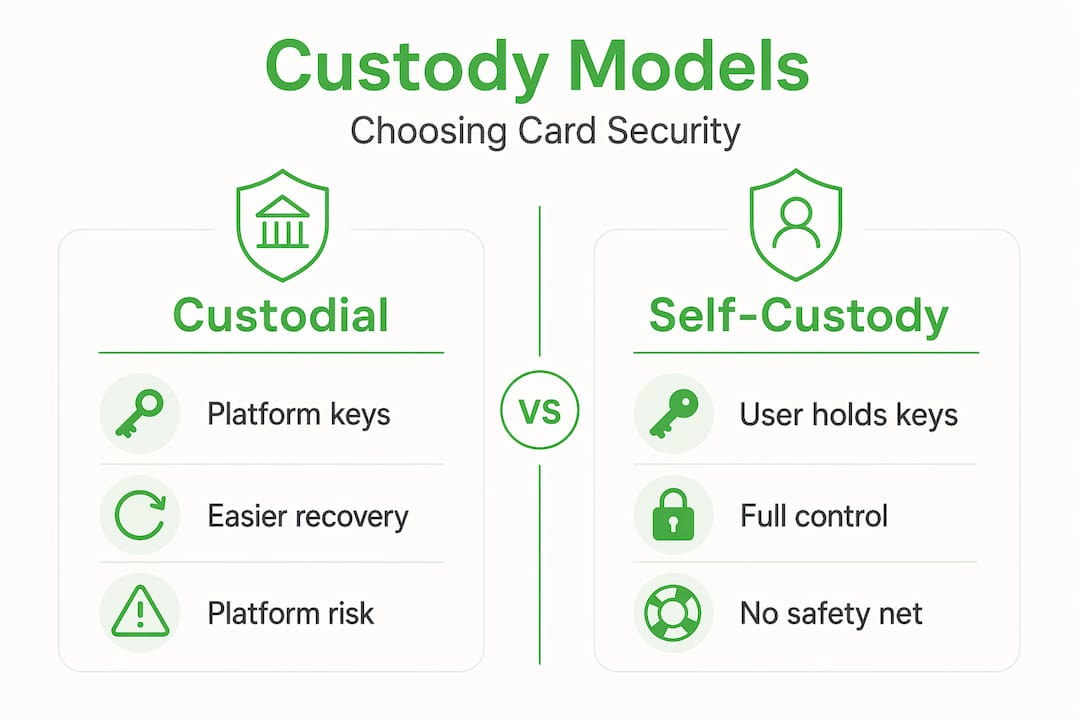
Not all platforms hold your digital cards the same way. The custody model determines who controls the keys, and therefore who controls your assets. Understanding the difference is one of the most practical things you can do as a collector or investor.
| Model | Who holds keys | Recovery options | Best for |
|---|---|---|---|
| Custodial | Platform | Platform-managed | Casual users, convenience-focused |
| Self-custody | You | Seed phrase backup | Experienced users, high-value holdings |
| Multi-party computation (MPC) | Shared key shards | Social recovery, co-signers | Investors wanting control with backup |
Custodial platforms are convenient but carry platform risk. If the operator becomes insolvent, your cards and funds may be frozen during proceedings. Private key protection is the determining factor in custody security, and custodial platforms vary widely in how seriously they take it.

Self-custody gives you full control but zero safety net. Lose your seed phrase and your assets are gone permanently. MPC models offer a middle ground. Key shards and multi-party computation distribute control so no single point of failure can wipe out your holdings, while still allowing recovery through designated co-signers.
When evaluating any platform, look specifically for disclosures about key storage, insurance coverage, and what happens to your assets in the event of platform failure. Marketing language about "bank-grade security" means nothing without specifics.
Pro Tip: Ask directly: does the platform use HSMs, and are assets held in segregated accounts? A platform that cannot answer clearly is one you should not trust with significant holdings.
Secure practices for gamers and collectors
Technology alone does not protect you. Your own habits account for a large share of the risk. These practices apply whether you are trading Pokémon cards, gaming gift cards, or digital collectibles:
- Verify sources before any transaction. Only buy and sell through platforms with documented verification processes. Region and platform mismatches on digital codes are a common source of disputes. Learn to spot listing scams before they cost you.
- Keep detailed transaction records. Screenshot confirmations, save order IDs, and log trade details. If a dispute arises, documentation is your only leverage.
- Use phishing-resistant authentication. Wherever a platform offers hardware key or card-based MFA, use it. SMS codes are better than nothing but are still vulnerable to SIM-swapping attacks. Reviewing card authentication options helps you understand what each method actually protects against.
- Never reuse credentials. A password used on a gaming forum that gets breached becomes the key to your card platform if you reuse it. Use a password manager and generate unique credentials for every account.
- Understand provenance before buying. Digital assets with no clear ownership history or verification trail carry higher fraud risk. Platforms that display provenance data give you a meaningful way to assess what you are buying.
Pro Tip: Set up a dedicated email address exclusively for card platform accounts. This limits your exposure if other accounts are compromised and makes phishing attempts easier to spot.
The future of digital card security
The security tools available to collectors and investors are improving, but so are the attacks. Several developments are worth watching in 2026 and beyond.
Smart contract wallets with programmable spending limits are gaining traction. Programmable wallet limits and social recovery let you cap daily transaction values and designate trusted contacts who can help recover access without exposing your private key.
Hardware-backed cryptographic authentication is moving toward mainstream adoption. The goal is to replace passwords entirely with device-bound keys that cannot be exported or phished.
Policy engines are becoming more sophisticated. Effective enterprise custody now combines server-side policy validation, multi-party approval, and on-premises signing to create a system where no single compromised component can authorize a fraudulent transaction.
Regulatory pressure is also increasing. Standards around key protection and custody disclosure are tightening in major markets, which will push platforms toward more transparent and auditable security practices.
The remaining challenge is UI-layer risk. As the Bybit exploit demonstrated, even sophisticated users can be deceived by a compromised interface into approving transactions they did not intend. The solution lies in signing environments that are completely isolated from the user interface, a design principle that more platforms are beginning to adopt.
My take on platform security
I have watched collectors lose significant holdings not because they were careless, but because they trusted a platform that looked legitimate and turned out to be built on marketing rather than real infrastructure. The pattern repeats. A platform launches with a polished interface, builds a community, and then either fails operationally or gets exploited because the underlying security architecture was never properly designed.
What I have learned is that convenience is the enemy of security at the platform selection stage. The platforms that make onboarding frictionless often do so by cutting corners on custody design, key management, or authentication requirements. That trade-off is invisible until something goes wrong.
My advice is to treat platform auditing the same way you would treat due diligence on any investment. Read the custody disclosures. Ask about HSMs. Check whether the platform has published a security audit from a recognized third party. If the answers are vague or the documentation does not exist, move on. The value you protect by choosing carefully far exceeds any convenience you gain by choosing fast.
The best collectors and investors I know are not the ones with the most assets. They are the ones who have never had to start over.
— sanjay
Secure your collection with Pepecards
Pepecards is built for collectors, gamers, and investors who take the security of their digital cards seriously. The platform applies industry-standard tokenization to every transaction, meaning your card data is never stored in a form that can be replayed or stolen. Multi-factor authentication is built into the account structure, not bolted on as an afterthought.
Pepecards is transparent about its custody architecture and works with verified partners to keep assets protected. Whether you are depositing funds for the first time or managing an active trading portfolio, the platform gives you the controls and disclosures you need to make informed decisions. Collectors and investors who want a platform that prioritizes security without sacrificing usability can create an account and start trading with confidence. Visit Pepecards to learn more about the security features and custody model before you commit.
FAQ
What makes a digital card platform secure?
A secure digital card platform uses tokenization, cryptographic multi-factor authentication, hardware security modules for key storage, and independent policy engines to validate transactions. Transparency about custody models and published security audits are additional markers of a trustworthy platform.
What are the biggest risks of unsecured digital card platforms?
The main risks include account takeover through phishing, token interception, counterfeit asset fraud, and platform insolvency that can freeze your holdings. Platforms without proper key management or authentication controls expose users to all of these simultaneously.
What is the difference between custodial and self-custody models?
In a custodial model, the platform holds your private keys and controls access to your assets. In self-custody, you hold the keys directly. MPC models split key control between you and trusted parties, offering a balance between security and recovery options.
How can I protect my digital cards from phishing attacks?
Use phishing-resistant authentication such as hardware keys or card-based cryptographic MFA instead of SMS codes. Never reuse passwords across platforms, and maintain a dedicated email address for card platform accounts to reduce exposure.
Why does platform insolvency matter for digital card holders?
If a platform becomes insolvent, assets held in safeguarding accounts may be frozen during legal proceedings. Unlike bank deposits, these accounts are not covered by deposit insurance, meaning recovery is uncertain and potentially lengthy.